


DeFi is an opportunity
DeFi protocols present great opportunities for investors to earn money. In a seemingly virtual DeFi ecosystem, you can earn real money, provided that you invest wisely, considering risks and taking into account certain important factors. But people who really make money on DeFi investments are the minority. Do you belong to this small group and if not, then why?
One of the problems of DeFi protocols is that there is no simple way to understand the profitability of your investments and analyze their performance consistently. From the data shown on the platforms’ UI, you can often see the amount of rewards, the expected annual or daily investment return rate, and the current value of the investment itself. But this is not enough.
In order to help investors, specialized dashboards have been created with the goal to simplify DeFi investment. And while they provide a lot of information, they still lack some of the critical information required for effective DeFi portfolio management.
Can rewards be trusted?
It often happens that investors, especially beginners who have recently entered the field of cryptocurrency, invest their funds in DeFi protocols primarly focusing at the amount of the rewards offered.
So, what are these rewards anyway? Rewards are a quantity of tokens paid to an investor by a DeFi platform for its use; for example, you can get DeFi rewards for providing liquidity to AMM protocols.
One of the challenges of DeFi protocols is that the reward yields are not consistent and tend to change (in some cases dramatically) over time. Let’s imagine you decided to use a known yield optimizer – Beefy.finance to invest in ETH-USDC liquidity pool in early 2022. When you were deciding to make your investment, the expected annual yield shown by the platform would have been 18%.
Let’s assume you stayed in the cryptocurrency market for the entire year despite the market correction of 2022. Now, at the end of the year, you would be expecting your investment 18% return. However, if you look at the current average yield, you may notice that it is only 5%. Fortunately, your average yield for 2022 would be 15%. Not bad, but still less than the expected 18%. The graph below shows how the APY of your investment changed over the year. As you can see, the percentage can change pretty drastically over time.
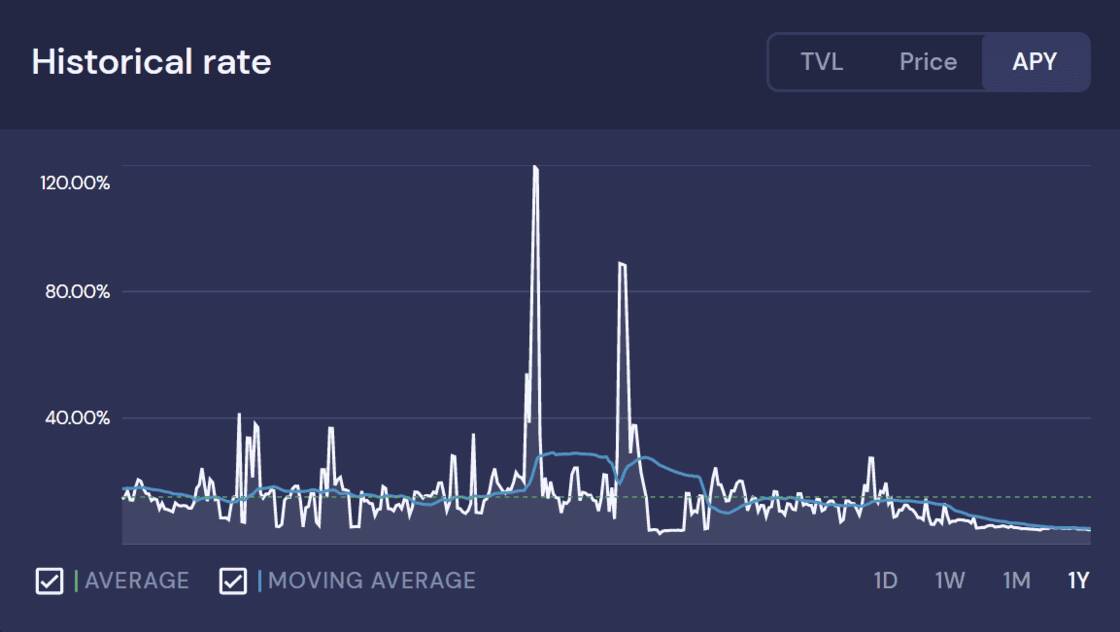
Taken from Beefy. finance
Therefore, the expected amount of future rewards should not be the only determining factor when choosing where to invest.
In which way do you earn the DeFi rewards?
Another issue to consider when choosing a DeFi investment is the way in which you earn the rewards. To begin with, we should understand the difference between the two principal ways in which reward payments can be carried out. Most DeFi protocols pay out rewards using their native token (the token that they issue themselves). For example, PancakeSwap pays them out in their own token – CAKE. Meanwhile, yield optimizers pay out rewards in the assets initially invested (deposited in a liquidity pool). They convert the rewards of an underlying platform into the tokens of the original investment. We will discuss the concept of yield aggregators in a separate article.
So, the kind of tokens the DeFi platform pays the rewards in is even more important than the actual rewards’ amount. Therefore, if you decide to invest directly in AMM platforms (provide liquidity), you should be aware that there is always a risk of devaluation of the token in which you will receive your rewards. In addition to this risk, remember that invested assets themselves can change dramatically in value. This change does not always mean growth.
Price changes matter
For example, let’s take the already mentioned ETH-USDC liquidity pool. This time, however, we will assume that the investment was made directly at PancakeSwap. In this case, you will receive rewards for liquidity mining in CAKE (the native token of PancakeSwap). Even though the percentage of return shown on both Beefy. finance and PancakeSwap at the time of the investment might be very similar, but the result after time passes might look different.
Let’s look at the price of the CAKE token for 2022. It has lost almost 70% of its value this year! Therefore, if you were to accumulate the rewards in CAKE, you’d have lost most of the value of your rewards. It should also be considered that ETH, one of the assets of this liquidity pool, has also significantly decreased in value (as did the overall crypto market). Consequently, if you were to invest directly at PancakeSwap, you would have incurred a potential loss in the value of your principal investment due to the price drop of ETH, as well as the reduction of the value of your rewards due to the price decrease of CAKE.
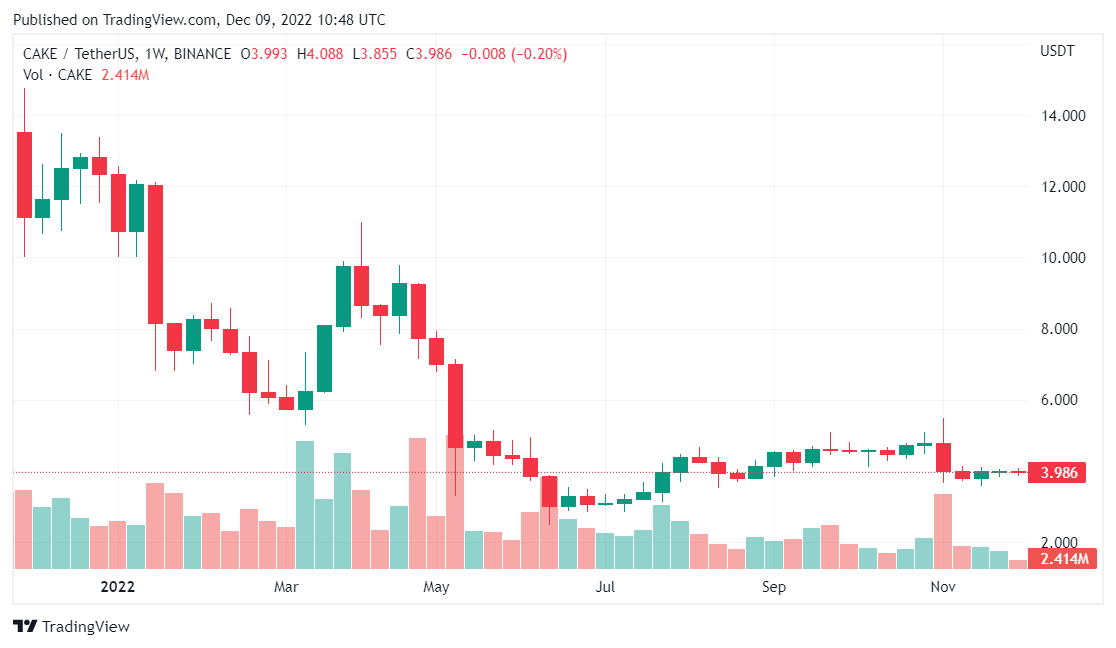
Taken from TradingView
Accordingly, your investment return would have been fairly different from what you may have expected initially.
Calculating the profit of the DeFi investment
If we were to analyze the previous example with most of the existing DeFi dashboards, we would not have necessarily seen the challenges discussed above. Let’s now do a specific calculation to illustrate how to analyze such an investment correctly. Let’s imagine that you invested $1,000 into the ETH-USDC liquidity pool and staked the LP tokens at PancakeSwap (0.109 ETH and 500 USDC) in the December 2021. At the time of the investment, your expected rate of return was 5.07% ($50.70 or 3.6926 CAKE as of 12/01/2021), paid out in CAKE.
Exactly one year later, you decide to check up on your investment. The quantity and the value of your ETH and USDC changed (because as ETH drops in price, the part of your USDC converts to ETH through arbitrage), you earned approximately 4.9730 CAKE as rewards. Taking into consideration the price as of 12/01/2022, the value of the rewards is $19.64. Consequently, the value of the rewards is less than expected. Your investment has also lost its value because of the price decrease in ETH.
So, your expected return of $1,050.70 suddenly turns into a loss of $453.03 (rewards’ value + change in LP value). This value that we have just calculated is called P&L of the investment. We have calculated the P&L of this DeFi investment manually using approximated values and without any dashboards. The result may not be exactly accurate, however, it still illustrates correctly the overall picture. The data from the 2022 was used here, and the 2022 is a year of crypto market correction. Doing the similar analysis with the data from the previous years will look more optimistic and profitable reduce.
Let’s see now what P&L really is and why it is important.
What is P&L, and why do you need it?
P&L is an indicator that shows whether your investment is generating you a profit or a loss. Simply put, if you sell your cryptocurrency for more than you bought it, you made a profit. It would be a loss if you sold your cryptocurrency cheaper than you bought it for (for the sake of simplicity we do not deal with short sales here). Tracking your investment profit and loss is the only way to know how your overall investment portfolio is performing.
P&L can be of two types: realized and unrealized. Unrealized P&L is a potential profit or loss that you can experience if you sell the asset. In contrast, if the asset has already been sold, the P&L is realized. We will explain the difference between these two types of P&L in details in a separate article. To get the exact data of your P&L, you need to consider transaction fees, asset’s value, rewards amount and other things. So, it is not very easy to perform this calculation manually every time. With Chainfulness, you can easily track the P&L of your investments.
Tracking P&L will help you manage better your own investments, taking into account the conditions associated with the cryptocurrency market. This approach will help you minimize the potential money losses. It will also reduce the number of unwise investment decisions. Tracking P&L enables you to identify what your most profitable investments are, so you can allocate more funds to them. As you can see, P&L is very important for DeFi investors.
Conclusion
If you are an investor in DeFi protocols, but you are still determining whether you are actually making money on your investments, then you should do a P&L analysis! P&L is one of the key indicators through which you can determine the profitability of your investment.
Using P&L can also help to determine how to properly rebalance your portfolio. Diversifying your investments is very important. You may often find yourself having similar investments . In this case, you can compare the historical performance of the P&Ls of these investments to diversify your portfolio properly.
With Chainfulness, you will be able to monitor the P&L of your investments and several other indicators necessary for an average investor.
We hope our explanations were helpful. Stay tuned for our new articles. We wish you only a positive P&L!
Invest wisely!