


DeFi has both opportunities and issues
DeFi continues growing, providing more opportunities for DeFi investment. Therefore, as an investor in DeFi, you can ask yourself a question: “Where should I invest my money and where can I get the biggest bang for my buck?”. The complexity of answering this question increases when you have multiple alternatives with similar risk and profit factors to form your DeFi portfolio.
However, while opportunities for DeFi investments are very attractive, these investments have potential risks and problems associated with them. These issues can be classified into two groups. The issues of the first group are related to the rewards and their value. The issues of the second group are related to the underlying value of your original investment. Let’s consider these problems in more detail.
DeFi risks and issues
The problems associated with the rewards of the DeFi investment are caused by variability of the APR. Indicators such as APR and APY are often extrapolated values that are approximate. In the subsequent articles, we will explain the difference between APR and APY in greater detail. The value of the expected DeFi rewards at the time when you make a deposit can differ greatly from the actual value of the rewards that you will realize in the future. The difference can be both positive and negative. The difference is especially felt during the periods of bear market when the actual fiat value of the DeFi rewards is lower than the originally expected value.
The second group of problems is related to the change of value of the principal DeFi investment. This can be primarily due to two reasons. The most important factor is going to be the change in price of one of the invested assets. You might feel this when you are investing in liquidity pools (due to the changes in token quantity as well as due to impermanent loss). And the second problem is the risk of potential exploit of the smart contracts, where you invest your funds. Buying an insurance can protect your DeFi portfolio from exploits of the protocols where you invested your funds. However, this usually reduces the profitability of your investments.
As time passes by, you might feel the negative effect of these issues more and more. The longer you stay in the investment which no longer generates the yield that you are expecting, the more opportunity cost you incur. Additionally, as price of your investment continues to drop, you are taking greater risk and accepting greater unrealized loss. The basis of your interest is getting lower as well.
“How to address these issues?” – you may ask. So, the general consensus is the diversification of your DeFi portfolio. However, the diversification is a double-edged sword. It minimizes the risk of total loss of the portfolio value, but it may create difficulties in management of the portfolio itself, especially around profitability.
Diversification is minimizing the risk
Let us now review some of the examples of investments to understand better how diversification can address some issues while creating others.
Let’s assume you want to invest $1,000. You feel fairly good about ETH and you found ETH-USDT liquidity pool on Beefy.Finance with an average return of 17.57%. You understand that you might incur some impermanent loss and you plan to stay in this investment for a while. In general, it might be a reasonable investment, ETH does seem like a good choice for the long term. However, there are some risks that the pool or the underlying platform might suffer an exploit or you might get lower profitability if the rewards’ quantity will drop (APR will drop).
Profitability becomes a problem especially if you are borrowing the money that you are investing. The interest you are earning on borrowed money must always exceed the interest you pay on your loan.
Alright, so how can you address these issues? You can make a diversification of your $1,000 in multiple similar pools, for example, ETH-USDT, ETH-USDC, and ETH-DAI. Even though they are not exactly equivalent, the risk and profit factors are very similar. In this way, we lower the risk of exploit, because we use multiple pools and the probability that somebody will hack them at the same time is lower. And now the profitability is going to be the average of the yield of these three pools. This is not likely going to change as drastically as a yield of any one individual pool.
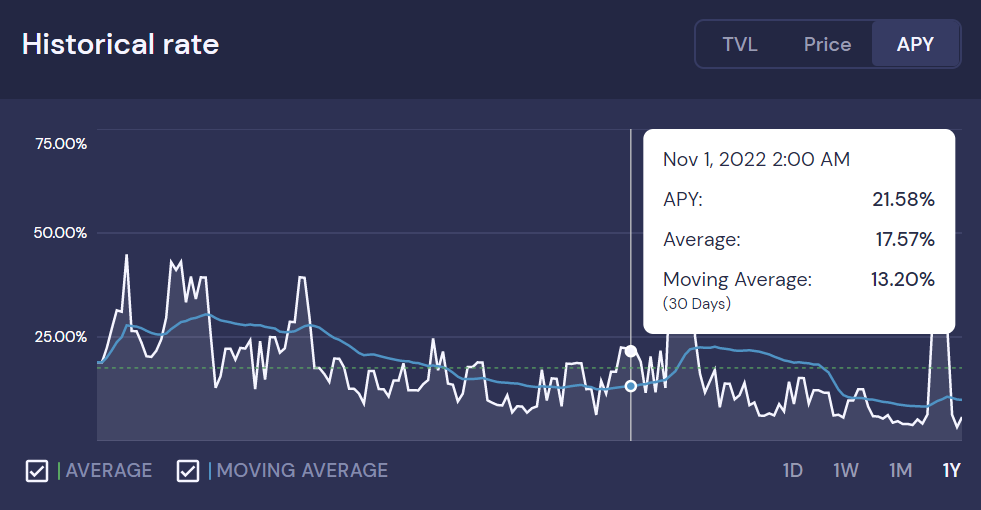
ETH-USDT
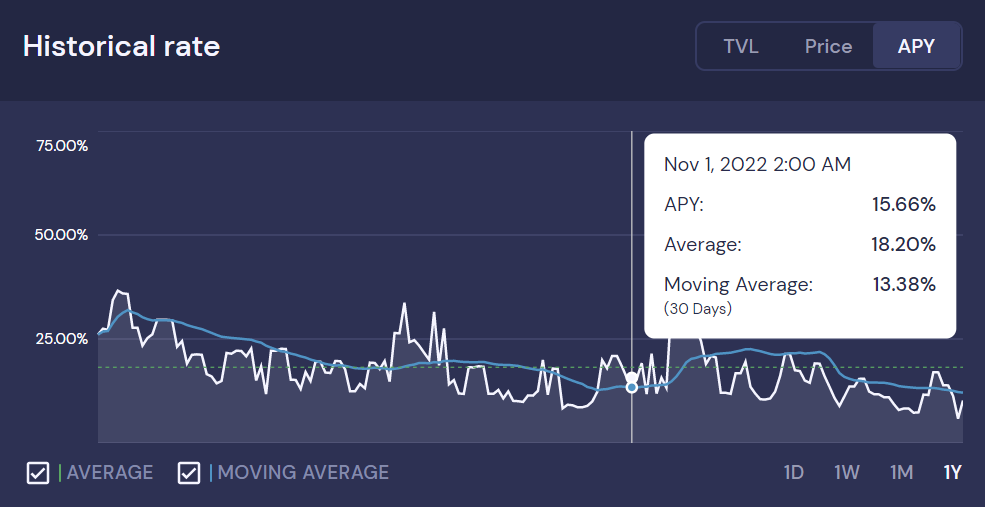
ETH-USDC
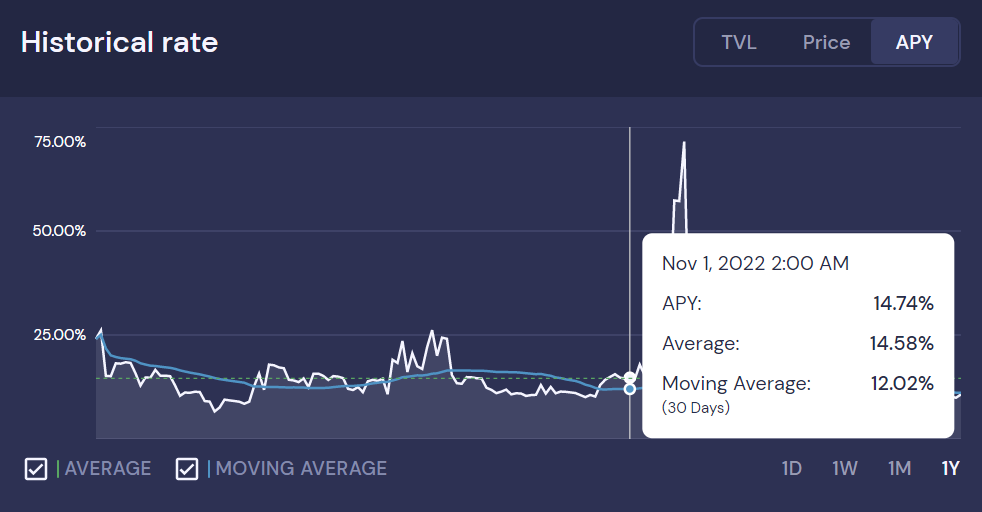
ETH-DAI
Taken from Beefy.finance
Analyzing the DeFi portfolio
Let’s assume, you invested in these three pool on November 1, 2022. One month later, you would have concluded that ETH-USDT generated 1.73%, USDC-ETH and ETH-DAI – 1.85% and 1.41% respectively. At this point, you have to make the conscious investment decision to address your long-term investment goals. That’s where the management of your DeFi portfolio goals becomes important.
If, as an investor, you want to maintain higher level of diversification and, potentially, lower risk, you may choose not to reallocate anything and to keep all your eggs divided equally among different baskets. However, if you want to maximize your return, you may choose to reallocate. In our example this could mean moving some funds from ETH-DAI into USDC-ETH; while in this specific example, the difference of 0.44% might not justify reallocation, in other similar situations the difference can be higher and therefore reallocation decisions would be more relevant.
The return generated by the investment in a given time period is referred to as historical performance of this investment. As we can see from the previous example, this value is going to play a significant role in your decisions regarding diversification and DeFi portfolio rebalancing. Let’s find out what a historical performance is in greater detail.
What is historical performance?
Historical performance is an indicator that shows the fund’s performance over time, usually a month, a quarter, or a year. In the traditional investment approach, when a stock or a bond’s historical performance is analyzed, two factors are taken into account. The first one is the change in asset value due to the change in price. The second one is any additional profit coming from stock dividends or bond coupon payments. Therefore, when a DeFi portfolio’s performance is analyzed, both factors also have to be considered.
Historical performance is often used in two situations. First, if you are preparing to invest, you may want to review the fund performance of the pool, where you are going to deposit funds, and analyze the average expected return, if it is available. You should consider that numbers will be approximate and not every protocol shows this data. The second and more significant situation is when the investment has already been made, and you want to understand how much you are actually earning, as well as whether some of your investments are performing better than the others, and whether subsequent reallocation of the DeFi portfolio is necessary.
You need a mechanism that would take snapshots of historical performance of your individual investments, and would format the data using a common time and price denominator, allowing you to compare these investments to each other, and make subsequent conscious decisions about reallocations based on your risk tolerance and desire for profit.
Most of the protocols as well as dashboards, show you the state of the DeFi rewards of your investment at the time when you look at it. If you want to track these parameters historically, you basically have to copy them by hand. It is generally a time-consuming task, requiring discipline that most investors don’t necessarily have. But there is no point in worrying about it; Chainfulness, the best DeFi portfolio tracker, can do this for you!
Conclusion
We hope that by now you realize the importance of diversification and how analysis of the historical performance of individual components of your DeFi portfolio is critical to profit maximization. And if you don’t have an opportunity to prepare all necessary data manually, then Chainfulness can be the right solution for you.
With Chainfulness, you can easily monitor historical performance for all your DeFi investments and have access to the information necessary to rebalance your portfolio according to your long-term goals.
We hope that this article was informative and helpful. Stay tuned for new articles on our blog. We wish for all of your investments to always show an awesome historical performance!
Invest wisely!