


Liquidity mining as a way to earn in DeFi
Liquidity mining has become one of the most popular strategies for earning in the world of DeFi. Most of the liquidity mining platforms have “-Swap” in their name because the goal of these platforms is to exchange one cryptocurrency for another. To be able to swap one cryptocurrency for another, the forum requires liquidity. If a person wants to exchange USDC with BTC, the platform must have BTC available. The need for this liquidity creates an opportunity for so-called liquidity mining.
Liquidity mining is a method of earning DeFi rewards by depositing your cryptocurrency (providing liquidity) into a liquidity pool (or LP) of Swap/AMM protocols. These rewards usually come from trading fees charged to users who exchange tokens.
But, before jumping into liquidity mining, you must understand some risks associated with this process.
Provide liquidity in equal proportions
You have to deposit your funds into a liquidity pool to provide liquidity. Most liquidity pools involve at least two tokens, usually in equal proportions. For example, the ETH-USDC liquidity pool will expect you to deposit in two equal parts, ETH and USDC (50% of ETH and 50% of USDC). To invest $1,000 in the ETH-USDC LP, you must deposit $500 in ETH and $500 in USDC. And this creates a potential problem.
The nature of the impermanent loss
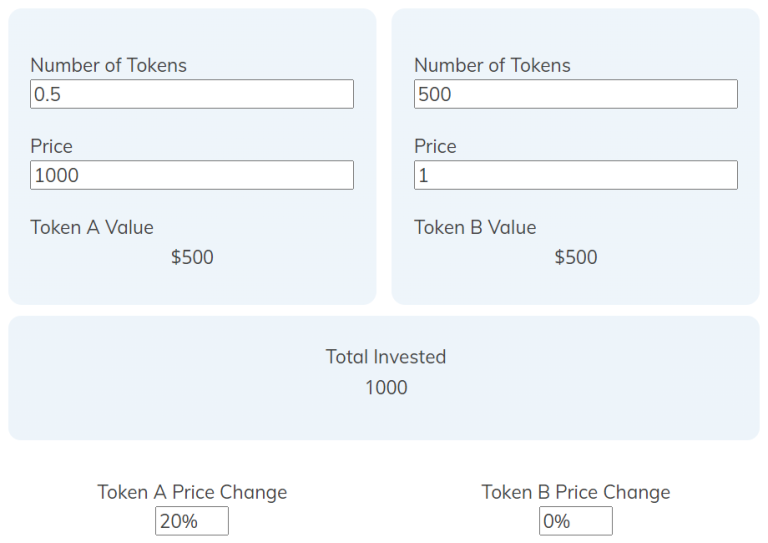
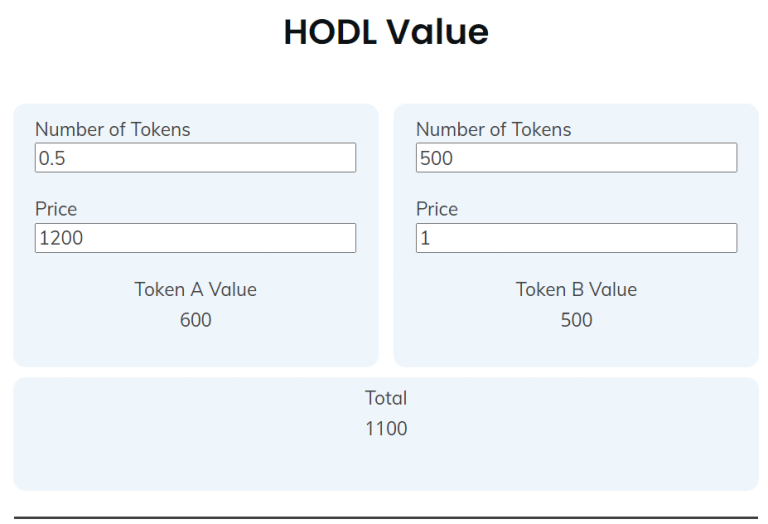
Let’s assume you invested $1,000 in the ETH-USDC LP. When you invest, 1 ETH = $1,000, and 1 USDC = $1. So, you deposited $500 in ETH (0.5 ETH) and $500 in USDC (500 USDC). And then, during the month after you made the deposit, the price of ETH increased from $1,000 to $1,200. If you were holding 0.5 ETH and 500 USDC in the crypto wallet separately, the combined value of these tokens would have been $1,100.
However, when investing in the liquidity pool, the process of arbitrage is performed by third parties (that make money doing so) to ensure that LP has equal proportions of ETH and USDC. As a result, as the price of ETH increases in our example, some of your ETH is converted into USDC. So, you have a smaller quantity of ETH and, therefore, a lower combined value of your investment at the moment when the price of ETH increases.
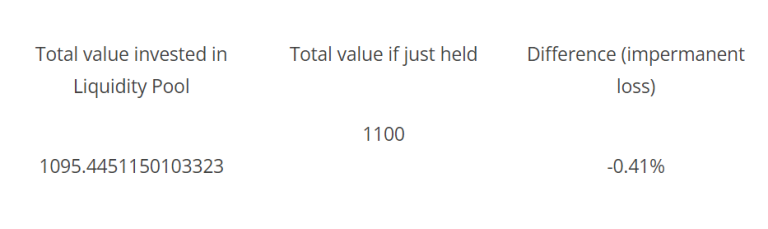
Understanding how much your DeFi investment would be worth if you just HODL is pretty straightforward (we have done this calculation above). However, how can you calculate the value of the tokens invested in a liquidity pool? You can use a special calculator! Below you can see the calculations taken from one impermanent loss calculator.
Taken from WhiteboardCrypto

Taken from WhiteboardCrypto
Taken from WhiteboardCrypto
Taken from WhiteboardCrypto
“Where’s my $4.55?!” you may ask. Well, this is the amount of impermanent loss. In this case, it is 0.41%.
What is impermanent loss in liquidity mining?
In general, the impermanent loss is a concept that refers to a situation where the profit you make by placing a token in a liquidity pool is less than what you would have earned by simply holding the asset (HODL). If you had decided to hold ETH and USDC separately, your total asset value after the price increase of ETH would have been $1,100. Impermanent loss occurs when two or more assets are invested in a liquidity pool, and the price of one asset changes significantly relative to the price of another asset. The greater this price change is, the more your assets are exposed to impermanent loss.
It is important to note that this loss is called “impermanent” because it has not been realized yet. You must withdraw money from the liquidity pool to take this loss. And if the assets’ price returns to the initial point over time, you will not experience any loss at all.
Is impermanent loss that dangerous?
Losing money is never a good thing. However, the impermanent loss might not be as scary as many think. In the case of liquidity mining, the mining rewards can cover the impermanent loss.
Rewards are a quantity of tokens paid to an investor to provide the DeFi protocol liquidity. You can get DeFi rewards for providing liquidity to Swap protocols.
Plan to invest long-term (several months or more). The expected impermanent loss over this period is relatively low, while the predicted amount of rewards paid for liquidity mining is relatively high. The impermanent loss might not be that dangerous.
However, the impermanent loss can become a problem when the prices of the invested tokens diverge significantly. In this case, your impermanent loss will be much higher. The rewards will take a few months or even years to cover such a significant impermanent loss. In addition, there is always a risk that the reward token (the native token of a Swap platform, in which your DeFi rewards are paid) might drop in price significantly. In this case, your rewards’ value will also decrease unless you use a yield aggregator.
But there is no need to worry about it too much! DeFi is constantly evolving, so there are platforms that offer to offset your impermanent loss by offering impermanent loss protection.
What is impermanent loss protection?
Impermanent loss protection (ILP) is crypto insurance that protects your investments against impermanent loss. The platform where you have invested your assets can provide ILP. Bancor, PancakeSwap, UniSwap, Pangolin, and others do offer this type of insurance, which is free.
How does it work? Every day from the moment you deposit your tokens in the liquidity pool, you get 1% of impermanent loss coverage. This coverage increases to 2% after two days, 30% after thirty days, and up to 100%. If your rewards cover the impermanent loss, the ILP will not apply.
For example, let’s assume you invested in a platform’s liquidity pool, held the money for 50 days, and then decided to withdraw your deposit; let’s assume that at the moment of withdrawal, the amount of the impermanent loss was $20. If your chosen platform provides ILP, then the platform would cover $10, or 50% of the liquidity pool’s impermanent loss, because you held your deposit for 50 days.
But as you know, the best way to solve a problem is to prevent it from happening. Let’s take a look at how you can avoid impermanent loss.
Strategies to avoid impermanent loss
– Invest in stablecoins or nonvolatile tokens. Less volatile pairs are less likely to experience significant price fluctuations and are less prone to impermanent loss. However, you should consider that the DeFi rewards for such tokens will be much lower than if your LP consisted of volatile crypto tokens. In the case of stablecoins, although you wouldn’t be able to earn anything on token price appreciation, you won’t lose anything either.
– Invest in trusted platforms that provide ILP. Having ILP from the platform will allow you not to worry about impermanent loss. Even if it occurs, the platform will cover it!
– Diversify your portfolio. Diversification is the most effective way to reduce any investment risk. In case of impermanent loss, the way to diversify is to decide what annual reward rate you would like to have and which assets you would be willing to hold. You can choose several pools that will yield the average return you want, but you would have different combinations, and therefore the risk of experiencing high impermanent loss on all of them would be lower.
Mastering the impermanent loss
Don’t be afraid of impermanent loss! Master it! Impermanent loss can be compensated by the rewards or the platform you invested in. You have to accept the impermanent loss only in rare cases.
However, to prevent the impermanent loss, follow the simple rules of DeFi risk management: invest in nonvolatile tokens, use platforms that provide ILP, and, most importantly, diversify your portfolio.
We hope this article has reduced your fears about the impermanent loss in DeFi investments. Stay tuned for our new articles.
Invest wisely!