


Exploring Crypto Investment Options
Have you heard about the potential for making high profits with crypto investments? But did you also know that crypto investments come with their fair share of challenges and risks? Many people who invest still don’t fully understand whether they are actually making a profit on their investments. In this article, we will delve into this topic and ensure that you understand how to analyze your earnings. Let’s start!
Let’s begin by looking at the various opportunities for profit-making in DeFi. DeFi offers enticing options for relatively significant returns on your investments. Generating revenue through DeFi investments is commonly known as “yield farming.” This strategy involves three primary approaches: staking, liquidity mining, and lending. Let’s take a brief look at each of these strategies first.
What is Staking?
Staking involves a process where blockchain users lock up their assets within the blockchain to enhance its security and validate transactions. This option is available on blockchains that utilize the Proof of Stake (PoS) consensus mechanism – Ethereum, Polygon, and others. Investors participating in staking can delegate their tokens to validators or act as validators themselves. This engagement enables investors to earn rewards from the blockchain system generated from gas fees, which are paid for transactions to complete. Staking can be done directly on the blockchain or through specialized platforms that offer liquid staking. An example of such a DeFi protocol is Lido.
What is Liquidity Mining?
Liquidity mining is a DeFi investment strategy where individuals (investors) provide liquidity to a decentralized exchange (DEX) or a DeFi protocol by depositing their digital assets into the platform’s liquidity pool to facilitate the swaps. The DeFi platform that owns the liquidity pool gains the liquidity needed to facilitate token swaps with its users. In turn, investors receive rewards from the platform – a portion of the trading fees charged by the platform to its users for swapping tokens. These rewards are paid as additional tokens, often the platform’s native tokens. The most popular platforms offering liquidity mining opportunities include DEXs like PancakeSwap, UniSwap, and SushiSwap.
What is Lending?
Crypto lending is a strategy where an investor (lender) transfers their crypto assets from their wallet to a DeFi platform’s smart contract, allowing a borrower to utilize these funds. The lending strategy is a bit similar to liquidity mining. However, in this case, funds are provided not to facilitate swap operations, but to offer loans to borrowers. In return, the lender receives a portion of the interest paid by the borrower.
It’s important to note that this income is typically paid to a lender with the tokens he initially deposited to the platform. So, if you provide liquidity in BTC, the interest will be accrued in BTC as well, unlike in the liquidity mining strategy, where the rewards are paid in the native token of the platform. Some popular lending/borrowing protocols include Aave, Compound, and Venus.
You can find more information in our article to understand these yield farming strategies better. These three strategies allow investors to generate a decent income from their crypto investments. While lending and staking profits are generally limited to 3-5% annually, DeFi profit from liquidity mining can sometimes even reach double digits (in the current market conditions).
At first glance, these strategies seem entirely different. While that’s accurate, they share one group of issues aside from investment risk. These issues are related to understanding the profitability of investments. Ignoring these challenges can lead to misunderstandings about the profit generated from DeFi investments. So, before beginning to invest in these strategies, it is crucial to understand which factors affect your profitability and, therefore, how to analyze your profit correctly. Let’s delve into the details.
Challenges of Understanding Profits in DeFi
In the exciting world of crypto investments, there’s a common pitfall that many investors encounter. They eagerly invest their money, expecting the promised returns from the platform, but then may find out that the actual earnings don’t match their expectations. Wondering why this occurs? Often, these investors don’t understand essential factors that should be considered when analyzing your DeFi investments’ profitability. Let’s review what these factors are.
The Variable Nature of APR
When you open a savings account or a CD (Certificate of Deposit), you are guaranteed to earn a stable APR, which is stated when you open an account. However, in the DeFi realm, things are different. The APR that you can see when you make an investment in DeFi is not guaranteed or fixed. DeFi profits can fluctuate, and sometimes very frequently. To grasp this concept, let’s consider a scenario.
Say you venture into liquidity mining and opt for the USDT-USDC-DAI liquidity pool on Balancer for your investment. If you were to invest in this pool when this article was written, you’d notice that the APR of the pool is shown as 5.16%. But what does this percentage mean? Well, it’s the annual return that people would receive a year from now if the daily rewards paid to the platform were the same as the ones paid in the last 24 hours.
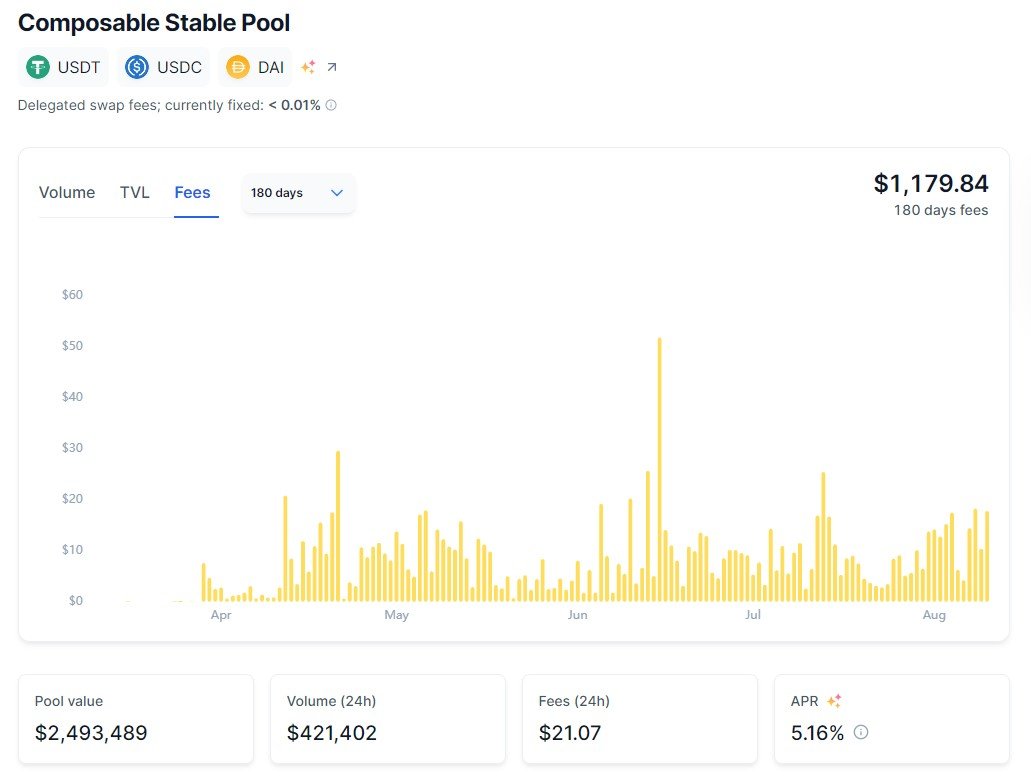
Taken from Balancer
However, as shown in the graph above, this annual return changes daily. So, the current APR shows the average profitability over a certain period (usually 24 hours). But, as you know, there’s no guarantee that this APR will stay the same. While it could go up, there’s also a good chance it might go down over time.
So, for instance, if you open a CD and are offered a 4.75% interest rate, this means that after a year, you are guaranteed to earn a 4.75% return on your investments. On the other hand, if you come across this percentage in the world of DeFi, it means that if you invested exactly a year ago, you’d have gained a 4.75% return as of now.
But why does APR change so dramatically? The answer lies in the popularity of the token pairs used for swap operations. For instance, a token pair USDC-DAI, whose liquidity is provided by the respective pool USDT-USDC-DAI, might be used ten times one day, while it could be used 25 times the next day.
The shifting popularity of the token pair among the platform’s users leads to fluctuations in fees earned by the platform, ultimately impacting the profits gained by investors in the respective pool. For example, changes in the cryptocurrency markets can occur, the platform can suffer an exploit, competitors may emerge, taking a share of the traffic for themselves, or the platform’s activity could be influenced by what’s known as seasonality; other factors can come into play. In that case, the investment’s profitability would change significantly, making the preliminary forecast regarding the platform yield irrelevant.
It’s important to note that reward fluctuations are present in any DeFi strategy – whether it’s liquidity mining, lending, or staking. It’s a common aspect of the DeFi landscape. While this shouldn’t necessarily cause worry, staying informed of this problem is wise. That’s why regularly monitoring the interest rates of your crypto investments is critical. This is especially important when you invest funds previously borrowed at a specific interest rate. You might want to explore better opportunities if your expected gains aren’t materializing.
Remember, as it is often said on Wall Street: “Past Performance Is Not Indicative Of Future Results.” Keep that in mind!
Rewards' Value Change
The second issue arises from how the promised APR is paid to you. For instance, most platforms pay out rewards with their native tokens, not with what you have initially invested. Most popular protocols have their token that they use to pay rewards. Among the most popular ones are UNI by Uniswap, CAKE by Pancakeswap, SUSHI by Sushiswap, and XVS by Venus. But where is the problem? Let’s look at the example to understand the issue better.
Imagine you put $1,000 into a USDC-USDT pool on Sushiswap a month ago. When you made the investment, you expected an annual return of 12%. Hopefully, you earned rewards worth $10 after a month (which is 1% of your initial investment). However, your reward is paid out in SUSHI tokens. And this may cause a problem.
When the cryptocurrency market is doing well (often called a bull market), the price of SUSHI tokens might increase. It means that the value of your rewards will be higher as well. However, considering the current situation, the price of SUSHI has dropped. To grasp this, take a look at the performance of the SUSHI token over the past year, as shown in the graph below. The token’s value has fluctuated significantly.

Taken from TradingView
So, if you were to keep your rewards in this token, their value would decrease significantly over time.
Receiving rewards in platform tokens introduces an element of risk. To mitigate this, you could regularly claim the rewards and convert them into stablecoins or other crypto assets you have confidence in long term.
Given these challenges, gauging your actual DeFi earnings becomes a complex endeavor. What is the best course of action?
How to Maximize Profits of Your Crypto Investment
In the realm of crypto investments, addressing potential risks is crucial. So, we’ve compiled a set of recommendations to guide you through the process of navigating these challenges effectively.
1) Analyze Profit Over Time: As you already know, the APR of your DeFi investments can vary. Understanding the profitability of your DeFi investments involves closely monitoring their historical performance – the way how APR changes over time. It is vital to analyze your investments in terms of the total profit you have received and the profit in terms of specific timeframes. These time intervals are snapshots – say, one week or one month.
If you analyze the performance of your crypto investments and notice a drop in profitability compared to the previous period, it doesn’t necessarily mean you should withdraw your funds immediately. This could be due to seasonality. But if you observe a pattern of decreasing revenue over several periods (several weeks or several months), it could be a good idea to think about moving your funds to a more promising investment option.
2) Use Yield Optimizers: As mentioned earlier, specific platforms offer rewards in the form of their tokens, which can often be quite volatile in terms of price. This introduces some level of risk for investors. If investors choose to accumulate these rewards in the platform’s native token, there’s a chance that the value of their rewards might decrease over time.
To address this concern, a strategy you can adopt involves claiming your rewards a few times within a month and exchanging them for stablecoins or other crypto assets you want to hold long-term. However, it’s important to note that this strategy demands a commitment of your time. Additionally, if the transaction fees (referred to as gas fees) associated with the blockchain you’re utilizing are notably higher than the rewards you’re receiving, then pursuing this strategy might not be viable. As in such a scenario, the amount of fees necessary to claim and convert the rewards would be equivalent to or even higher than the amount of the rewards that you will claim. What should you do then?
Enter the world of yield optimizers, also known as aggregators. These platforms possess a unique ability to boost your earnings. Here’s how they work: You entrust these platforms with your funds, and they manage your capital – invest your funds and reinvest earned rewards – to generate higher returns. As they manage the aggregated capital of all depositors, the transaction fees they will pay to claim returns and convert them into other assets will make financial sense compared to the value of the rewards earned. The total value of deposits allows such operations to be performed even several times a day.
To delve deeper into aggregator mechanics, you can find comprehensive information here. The most popular yield optimizers include Beefy, Autofarm, and ACryptos.
But before diving into any protocol, ensure you’ve conducted thorough research on the protocol and understand all the benefits and risks of the investment strategy you chose. Also, remember that higher returns are attractive but often come with higher risks.
Final Thoughts
In conclusion, DeFi represents a groundbreaking financial realm that allows its users to earn passive income through activities like liquidity mining, lending, and staking. However, there’s a crucial aspect to be aware of – challenges.
We can roughly classify these challenges into two groups: those associated with safeguarding your invested capital and those connected to the profitability of your crypto investments. High APYs often seem overly optimistic and fluctuate significantly. Additionally, rewards are frequently distributed in the platform’s native tokens, which can experience a continuous decrease in value over time. How could you address these issues?
So, conducting your research (DYOR) before investing in any platform is essential. Once you’ve made your investments, it’s wise to periodically assess the historical performance of your investments over specific timeframes. While you can analyze your investment portfolio manually, you can save time using a DeFi portfolio tracker. One such solution is Chainfulness, which offers comprehensive tools to help you monitor your crypto investments effectively and analyze their profitability. Check it out now!
We hope this article has provided valuable insights and practical knowledge. Stay tuned for our upcoming articles as we continue to explore the world of DeFi. We extend our best wishes for your success and profitable endeavors! And always remember to:
Invest Wisely!