


A New Era of Lending
Are you familiar with DeFi lending but still need to figure out what it entails, how it operates, and the risks involved? You’ve come to the right place!
Lending and borrowing have always been crucial in the global financial system. Traditionally, banks and financial institutions held a monopoly on providing secure loans. Need a mortgage to buy your dream home? Head to the bank. Want to finance the latest gadgets? Seek a loan from a traditional lender or a bank. However, the emergence of new financial markets – CeFi (Centralized Finance) and DeFi (Decentralized Finance) platforms – has presented direct competition to banks and financial institutions when it comes to obtaining loans. Both CeFi and DeFi are closely connected to the world of cryptocurrencies.
CeFi platforms closely resemble banks; they are centralized and require clients to undergo mandatory KYC procedures for personal identification. Examples of CeFi lending include Nexo and YouHodler. On the other hand, DeFi lending platforms are decentralized projects deployed on the blockchain with full transparency of operations. This article will focus on DeFi lending and explore its various aspects.
What is DeFi Lending?
DeFi lending is a form of yield farming that enables individuals to borrow and lend funds without the need for traditional intermediaries such as banks. DeFi lending is conducted on the blockchain using smart contracts without customer identification. Some examples of such DeFi lending and borrowing platforms include Aave, Compound, Geist, and Venus, which are considered among the best crypto lending platforms available. “DeFi lending” encompasses both lending/borrowing and minting concepts. By the way, among the most well-known minting platforms are MakerDAO, Frax, and QiDAO. Now, let’s delve into the essence of lending and borrowing and understand how they work.

What Constitutes Lending in DeFi?
Crypto lending involves an investor (lender) transferring their crypto assets from their non-custodial wallet to a smart contract of a DeFi platform, allowing their funds to be utilized by the borrower, in order to earn passive income. The income is generated from the interest charged to the borrower. However, the crypto lending platforms typically pay out this income in their native tokens (such as COMP for Compound or XVS for Venus) or in tokens native to the blockchain (like AVAX on Avalanche, FTM on Fantom, MATIC on Polygon, etc.) on which the loan was made. Lenders often receive 3-5% annual interest as passive income on their invested amount.
What Constitutes Borrowing in DeFi?
Borrowing entails a borrower to obtain crypto assets from a DeFi protocol previously deposited by a lender. The borrower must then pay interest (usually around 3-6% annually) on the borrowed assets. Therefore, borrowers must pay back the borrowed amount and the accrued interest in order to repay the debt. Unlike with traditional finance, the borrower must always deposit the collateral first to get a loan from the crypto lending protocol. The collateral is the crucial aspect, which is connected to the “collateral factor” determining the maximum debt a borrower can get.
To explain this, let’s consider an example from real life. If you ever decide to take out a home mortgage from a bank, you will probably be required to make a 20% down payment. But only some people consider the rationale behind the down payment. In reality, if you cannot fulfill your mortgage payments, the bank has the authority to repossess the house and sell it, and your down payment allows the bank to do this at a 20% discount, ensuring a swift sale of the property.
In this respect, DeFi is quite similar to traditional finance, with one key difference. When you provide collateral to receive a loan from a crypto lending platform, you are eligible to borrow only up to 80% of the value of your collateral.
Loans on these DeFi platforms are often referred to as over-collateralized since the value of the collateral exceeds the actual debt’s value. DeFi platforms employ such measures to ensure the collateral can be liquidated if the ratio between collateral and debt reaches a critical level.
Some DeFi protocols also support non-collateralized loans – the so-called flash loans. However, they have very specialized use, so we will cover these loans in a separate article.
Why Borrowing Matters?
Now that you have learned about crypto loans, you may wonder why you should borrow at all. After all, some types of loans, such as personal loans and credit cards, you can get from a bank without even providing the collateral, just based on your credit history. In DeFi, however, to borrow, you already need to have funds to deposit as collateral. Since you already have some coins, why not go ahead and exchange them for whatever you need as a post to use them as collateral? On the surface, you are right, but the concept runs much deeper, and that is why it is so popular.
One common scenario in the cryptocurrency world is borrowing stablecoins to make purchases or to reinvest the borrowed funds in order to generate income. In such cases, individuals often provide as collateral those crypto assets that they intend to hold for a long time, such as Bitcoin and Ethereum. The expectation is that the price of these collateral assets will appreciate over time, allowing the borrower to benefit from potential price appreciation while still having partial access to the collateral’s purchasing power.
Let’s imagine that you have $10,000 and you need a car. With $5,000, you buy a used car; the other $5,000 you deposit in the bank account at a 3.5% annual rate. Everything seems fine, you got a car, and after a year, you will get $175 additional interest.
However, borrowing in DeFi opens up the opportunity to buy a car and earn more substantial interest. For example, you could buy $10,000 worth of BTC, deposit that Bitcoin as collateral, and borrow 5,000 USDC against it (which you can exchange immediately for US dollars in order to buy a car). You would have to pay about 3.5% interest on the borrowed 5,000 USDC for using the loan for a year.
If you hold this Bitcoin for several years and it grows by at least 3.5% annually (which has been historically the case), it will be much more profitable in the long term than in the first scenario with keeping that money in the bank account. This is the whole point of borrowing from DeFi.
Like any other cryptocurrency asset, Bitcoin does not solely experience value appreciation. It is necessary to consider the volatility of Bitcoin. Therefore, there is a risk that Bitcoin can lose its value. This makes the second option a risky endeavor.
By the way, talking about risk. Like any DeFi strategy with the potential for profitability, DeFi lending carries its own set of risks. Therefore, it’s crucial to familiarize ourselves with the risks associated with lending and borrowing in the DeFi space. When investing, the most significant risk is not fully understanding the process. So, let’s explore the potential risks of DeFi lending and borrowing, as being unaware of them can be highly detrimental.
What are the Risks of DeFi Lending and Borrowing?
When it comes to DeFi lending, both lenders and borrowers face certain risks that are inherent to the process. Understanding these risks is crucial for anyone involved in DeFi lending. Let’s take a closer look at some of the key risks involved:
Dynamic interest
Unlike traditional bank loans or deposits, where you can expect a stable and unchanging interest rate specified in the contract, DeFi lending platforms often have variable interest rates.
Interest rates usually fluctuate due to changes in the utilization rate. If the utilization rate of a specific asset on the DeFi platform increases, the Borrow APR also increases, creating a risky problem for borrowers. This was the situation on Aave when USDC lost its peg for several days in mid-March 2023. Many people were willing to borrow USDT instead of USDC, resulting in an increased utilization rate and Borrow APR for USDT. At one point, the Borrow APR reached almost 80% per annum! Conversely, there are cases when the utilization rate is very low, indicating the DeFi platform’s inability to generate profit for lenders.
Often, DeFi lending platforms offer a stable borrowing rate, but it is typically higher on average than the actual variable borrowing rate, even though the latter can occasionally undergo substantial fluctuations.
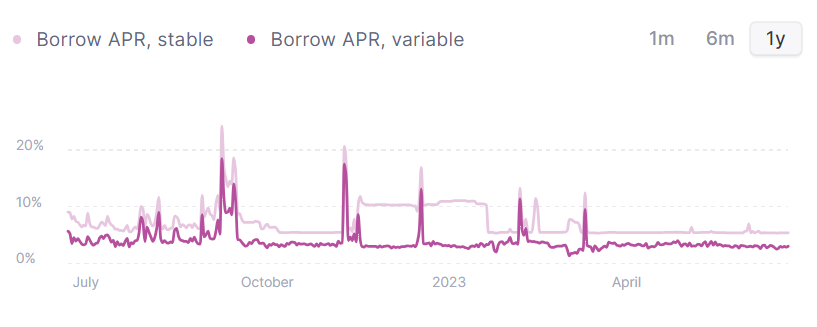
Taken from Aave
So, as a lender, dynamic interest means there is a risk of collecting lower profits than expected. On the other hand, if you borrow cryptocurrency from a DeFi platform, you may pay more interest than you initially expected.
Smart contract exploits
In traditional banking, you trust the security of the bank’s servers and have confidence that your funds, including your deposits, are protected. However, in the case of DeFi platforms, there is a legitimate concern about the security of your hard-earned money. DeFi platforms often use open-source smart contracts that are accessible to anyone. If even the slightest vulnerability exists in a smart contract, attackers can exploit it, potentially granting them full access to the funds held by the platform. While borrowers may lose their collateral, at least they will retain what they borrowed. On the other hand, lenders risk losing everything they have provided to the DeFi lending platform should an exploit occur.
Liquidation risk
As mentioned earlier, in DeFi Lending, you can only borrow if you have previously provided another crypto asset as collateral. However, if the value of your collateral drops significantly, there is a risk of losing a significant part of your invested capital, as the platform will automatically liquidate your loan.
Generally, lending platforms provide a fairly simple way to understand whether there is a risk of liquidation. Aave, for example, calculates a specific indicator known as the health factor. If the health factor of your loan is greater than 1, then your loan is in good standing. However, if it falls below 1, you risk being liquidated. Therefore, monitoring the health factor and ensuring it does not approach 1 is crucial. If you observe that the health factor of your loan approaches 1, you can return a part of the loan or provide some additional collateral.
Certain risks are specific to either lending or borrowing on a DeFi platform, and what may be risky for one can be profitable for the other.
Understanding and managing these risks is essential for anyone engaging in DeFi lending or borrowing. You can navigate the DeFi landscape more effectively by staying informed and making informed decisions.
Tips for Successful DeFi Lending
When it comes to DeFi lending, there are strategies you can employ to minimize risks and increase your chances of success. In this section, we will explore some essential tips that can help you navigate the world of DeFi lending effectively.
Conduct a Thorough Research
Before investing in any DeFi lending platform, it is crucial to conduct thorough research. Familiarize yourself with the platform’s reputation, security measures, and track record. Look for reviews, user feedback, and audits to understand its reliability.
Diversify Your Portfolio
Remember to keep only some of your eggs in one basket. Diversifying your portfolio across different platforms, blockchains, and cryptocurrencies is essential. Suppose you lend money on a DeFi platform and diversify your investment portfolio across multiple blockchains. Doing so can considerably minimize potential losses if an exploit occurs, as the exploit is likely to occur only on a particular blockchain, not all of them at the same time. So, diversification helps to spread out your risks and reduces the impact of any potential losses.
Be Cautious When Exchanging Borrowed Funds
In some cases you may borrow a specific cryptocurrency from a DeFi lending platform, but for various reasons, you may need to convert it into some different currency. However, it’s crucial to remember that the borrowed funds must be repaid in the exact asset that was borrowed initially. For instance, if you borrowed DAI, you are obligated to repay the debt in DAI as well.
So, if you have converted the borrowed DAI into ETH and, over time, the value of ETH has depreciated, you will have to cover the shortfall caused by the price depreciation of ETH using your own funds. This situation arises when you decide to swap ETH back into DAI to repay the debt.
Analyze Historical Performance and P&L
Once you have made your investments, it’s important to regularly analyze their historical performance and profit/loss (P&L) indicators. This analysis allows you to track the progress of your investments over time and identify any areas that may require adjustments. It is crucial to monitor Borrow APY as one of the components of historical performance, especially when reinvesting borrowed funds to generate additional income. This way, you can ensure that your reinvestment returns exceed the interest you should pay for using the loan.
That’s why reviewing your portfolio’s performance lets you decide whether to continue, modify, exit your lending positions, or repay a debt if you borrow funds.
Final Thoughts
DeFi lending offers a straightforward method to generate passive income from your cryptocurrency assets if you become a lender. Additionally, it is a good solution for borrowing crypto assets when you need funds. In essence, DeFi lending encompasses two key concepts: lending and borrowing. While both provide simplicity and profitability, they come with their own set of considerations.
As with any passive income-generating method, DeFi lending carries certain risks. These primarily include fluctuating interest rates, the potential for hacker attacks, and liquidation risk. However, you can mitigate these risks through simple strategies, such as conducting thorough research on the lending platform, diversifying your portfolio, and consistently monitoring the technical performance of your investments. More about making your DeFi risk management strategy you can read here.
We hope this article has provided informative and engaging insights into DeFi lending.
Chainfulness makes it easy for you to keep track of important factors that are crucial for achieving success in DeFi Lending. Give it a try today!
Stay tuned for our upcoming articles as we continue to explore this exciting field. We wish you great success in your future endeavors with DeFi lending.
Invest wisely!